The average U.S. household spent nearly $1,000 on heating last winter — a 9.2% increase from the prior year.[1] If you’re in Maryland or anywhere else that gets real cold, that number probably feels like an understatement. The good news: smart home automation isn’t just about convenience. It’s one of the most practical ways to reduce that bill without giving up comfort. Here are four things you can do right now — or build into your home if you’re installing a system for the first time.
Smart Thermostats Save More Than You Think
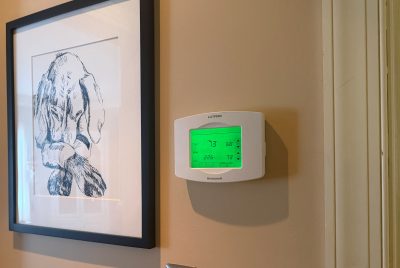
According to ENERGY STAR, the average homeowner saves 8% on heating and cooling costs annually by installing and using a smart thermostat — roughly $50 a year on average.[2] But the bigger savings come from people who consistently use the scheduling feature. Research from Resideo (manufacturer of Honeywell Home thermostats) found that users who regularly follow the recommended scheduling guidance save 22% on heating and 17% on cooling — an estimated $204 per year.[3] The gap between $50 and $204 isn’t just about the thermostat. It’s about using it. What this means for you: A standalone smart thermostat helps. A thermostat integrated into a whole-home automation system does a lot more. When it works with occupancy sensors, weather data, and automation controls, it doesn’t just follow a schedule — it anticipates when each room actually needs heat.
Smart Shading Uses the Sun to Your Advantage
Here’s one most people don’t think about: windows are a major source of heat loss. The EPA estimates that 25–30% of all heating energy escapes through windows.[4] Smart motorized shades can help in two ways:
During the day: Open south-facing shades to let the sun naturally warm your home
At night: Close shades to add an insulating layer against the cold
When integrated into an automation system, this happens on its own. You don’t have to remember to open or close anything. The shades adjust based on the sun’s position, the outdoor temperature, and your schedule. Lutron has built whole-home shading systems — learn more about shading, lighting, and HVAC management.
Lighting That Doesn’t Waste Energy
Holiday decorations, hallway lights, basement lights left on “just in case” — it adds up. But smart automation can eliminate that waste without you thinking about it. Motion sensors turn lights off when rooms are empty. Scheduling programs lights to dim or shut off at specific times. Smart switches can be set to automatically turn off after a period of no motion. The U.S. Department of Energy estimates that LED bulbs use 75% less energy than traditional incandescent bulbs and last up to 25 times longer.[5] Smart lighting systems let you combine LEDs with automation so the savings compound. And if you’re wondering whether automation defeats the purpose of LED efficiency — the answer is no. LEDs are the hardware. Automation is the brain that makes sure they’re only on when they should be.
Prevention Is Cheaper Than Repair
One of the most overlooked ways smart home systems save money is by preventing expensive problems. Smart temperature sensors can detect freezing conditions in basements, crawl spaces, or exterior walls. If the temperature drops below a critical point, you get an alert — and the system can automatically activate heat tape, adjust zone temperatures, or even call you before a pipe freezes. A burst pipe can cost thousands in damage and repair. A smart automation system that prevents it costs a fraction of that — and pays for itself in a single incident.
The Bottom Line
Cutting your winter heating bill doesn’t require a complete renovation. But it does require a system that works intelligently — one that adjusts automatically, prevents problems before they happen, and maximizes efficiency across your whole home. The most energy-efficient home isn’t the one with the smartest devices. It’s the one where the devices work together.
Jay Dibley is a principal at WR Integration, a whole-home automation and technology integration firm in Maryland. He has over 20 years of experience designing integrated systems.
Sources
[1] National Energy Assistance Directors Association (NEADA) / U.S. Energy Information Administration (EIA) — Average U.S. household heating cost for winter 2025–2026, up 9.2%. Cited in: AARP, How to Cut Costs, Lower Your Heating Bill This Winter — https://www.aarp.org/money/personal-finance/lower-heating-bills/
[2] ENERGY STAR — Average heating and cooling savings of 8% (average $50/year) from using a smart thermostat. — https://www.energystar.gov/
[3] Resideo / Honeywell Home — Users save 22% on heating and 17% on cooling with recommended scheduling, estimated $204 annual savings. — https://www.resideo.com/us/en/corporate/newsroom/featured-articles/how-to-cut-winter-heating-costs-with-smart-thermostats/
[4] U.S. Environmental Protection Agency (EPA) — 25–30% of all heating energy escapes through windows. — https://www.epa.gov/
[5] U.S. Department of Energy — LED bulbs use 75% less energy and last 25x longer than incandescent bulbs. — https://www.energy.gov/