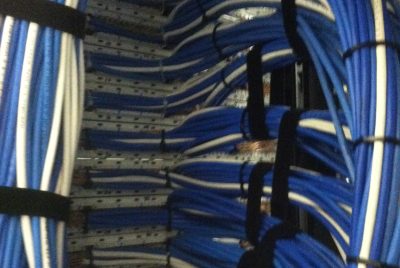
At WR Integration, we design whole-home solutions. The core is a network you never have to think about. A great smart home with a weak network is a beautiful house on a shaky foundation: everything else suffers.
That’s why we build the wired backbone first, then put Wi-Fi 7 on top of it — so every room actually gets the speed and reliability you paid for.
Lights, cameras, shades, audio, thermostats, video calls, streaming — none of that cares about a peak speed test in the room next to the router. They care whether the network holds up when the whole house is using it at once.
Wi-Fi 7 helps with that: more devices online together, less waiting when people are on calls in one room and 4K is running in another, and a cleaner handoff as you move through the house. But a new access point on old, messy wiring still sits on a shaky foundation. The cables, patch panel, and access-point placement are what make the Wi-Fi honest.
Here’s the reality: the average U.S. broadband household today connects 17 to 21 smart devices. That’s a lot of traffic competing for the same bandwidth. [1]
For homes with many connected devices, older Wi-Fi standards start showing their limits. Each device locks onto one frequency band, and when that band fills up, connections slow down or drop. You’ve probably noticed it: a camera goes offline during busy evenings, a voice command hesitates, or a video doorbell takes too long to respond. These aren’t random glitches. They happen when the network can’t keep up with what the house actually demands.
Wi-Fi 7 was built for this exact problem. The biggest advantage it brings to a smart home isn’t raw download speed — it’s whether your network can reliably serve dozens of devices at once without dropping any of them. A key technology called Multi-Link Operation lets devices use multiple frequency bands at the same time, so if one band gets crowded, your cameras and doorbells stay connected through the others. [1]
What this means for you: If you’re building, renovating, or tired of dead zones and dropouts, start with the network — not another gadget. Get the backbone right, then let Wi-Fi 7 do what it’s supposed to do.
Jay Dibley is a principal at WR Integration, a whole-home automation and technology integration firm in Maryland. He has over 28 years of experience designing integrated systems.
Sources
[1] Broadband Search, “Home Network Statistics 2026” — average U.S. broadband household connects 17–21 smart devices; Multi-Link Operation reduces latency variability in high-device-density homes. — https://www.broadbandsearch.net/blog/home-network-statistics